WebP & Performance · · 9 min read
Written by Saleh S.
Saleh S. - Author & Developer at IMG Harvest. Read author bio.
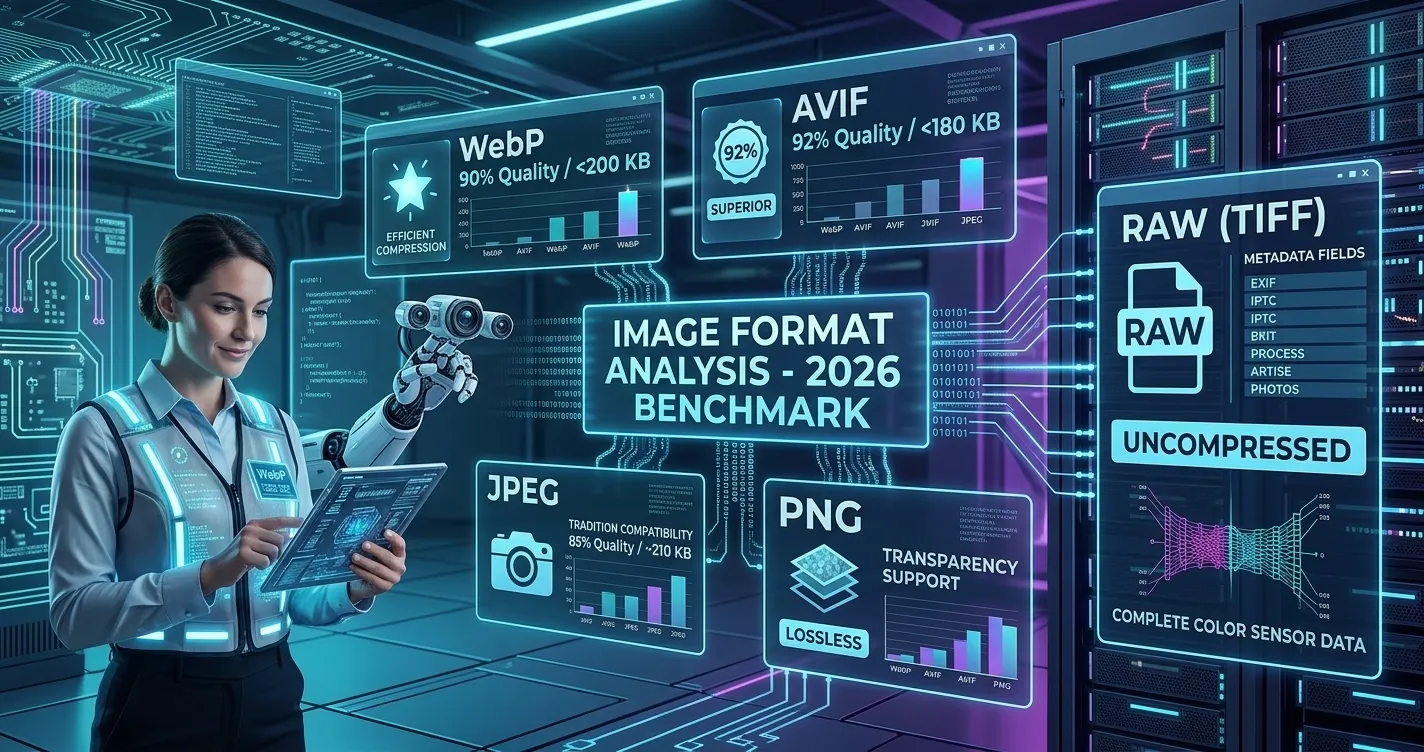
Your image format decision affects page speed, bandwidth costs, and visual quality. With WebP and AVIF now mainstream, the old JPEG-or-PNG choice is no longer the only one. Here is how the four major formats compare.
JPEG: The Universal Workhorse
JPEG uses lossy compression tuned for photographs and complex gradients. It is supported everywhere and encodes quickly, but files are noticeably larger than modern alternatives at equivalent quality, and it cannot store transparency.
PNG: Crisp Transparent Graphics
PNG is a lossless format built for sharp edges, logos, text, and UI graphics that need transparency. Its downside is size: photographic PNGs bloat quickly, making it the wrong choice for photos and hero images.
WebP vs AVIF: The Modern Contenders
WebP delivers files 25% to 34% smaller than equivalent JPEGs and 26% smaller than transparent PNGs, with native support in every major browser. AVIF goes further with up to ~50% smaller sizes than JPEG, but encoding is slower and support, while strong, is still maturing on some platforms.
- JPEG: best compatibility, mediocre compression, no transparency.
- PNG: lossless and transparent, but heavy for photographs.
- WebP: the best all-around balance of size, quality, and 97%+ browser support.
- AVIF: maximum compression for modern browsers, higher encode cost.
Key Takeaways
There is no single perfect format. Match the format to the image's purpose: WebP for everyday photography and graphics, PNG for transparency-sensitive assets, JPEG as a legacy fallback, and AVIF when maximum compression wins.
Ready to put it into practice? Try the WebP to JPG / PNG converter - free, in-browser, and private.